
P2P crypto trading has become essential in countries where banking hurdles, withdrawal limits, and foreign exchange rules make traditional crypto purchases difficult. Nations like Pakistan, Ghana, Nigeria, India, and several in Latin America are increasingly onboarding people into the crypto economy through P2P platforms.
P2P trading offers clear advantages. Users can negotiate prices, select payment methods, and transact without waiting for order books to clear. However, these same features also carry risks, including fraud, social engineering, chargebacks, website cloning, and impersonation. Legal protections are often limited, making caution crucial.
This guide aims to help both new and experienced P2P traders navigate these risks safely. By learning from others’ experiences, you can avoid common pitfalls and enjoy secure, successful trading, whether you’re completing your first trade or managing multiple transactions.
Why P2P Safety Should Be a Priority
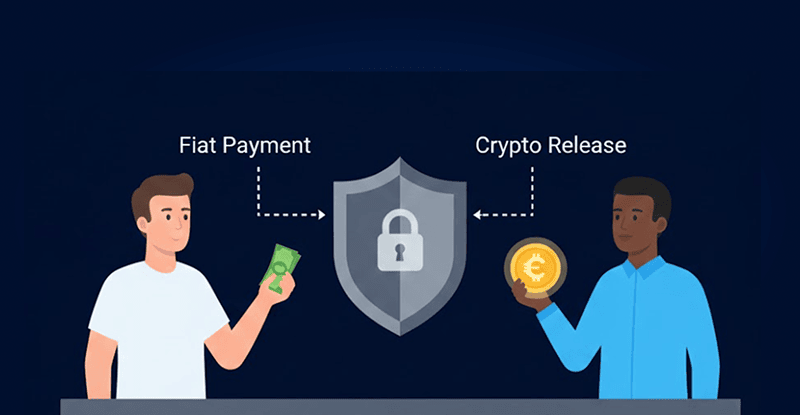
P2P (peer-to-peer) trading allows buyers and sellers to interact with one another, in most cases, via an escrow system designed to protect both parties.
This format works well, but also draws a mixed bag of user types. They may include seasoned traders, well-intentioned newcomers, opportunists, and, of course, scammers. However, this doesn’t mean that P2P is unsafe. It means that P2P needs an adequate level of caution.
Most seasoned traders develop a mindset of “P2P Safety Word of the Day,” in which they choose one small thing to focus on every single time, be it verification, identity, timing, IP address security, or platform alerts. Though it’s not about being overly cautious, a safe mindset is about consistency.
Once you get a proper understanding of how some of the risks work, you will be able to address them without any hassles. The following is a list of the most practical and richly experienced insights on the Safe and Successful P2P Trading, Top 10 tips.
Top 10 Tips for Safe and Successful P2P Trading
Here are 10 solid tips for safer, smarter P2P trading—straight from people who’ve been there:
1. Stick to Verified, Reputable P2P Platforms
How do you know a platform is verified and reputable?
Look out for its escrow policy. Check whether it supports KYC. Find out if it’s against money laundering. See their approach and how long they take to resolve a dispute. Most importantly, check feedback and reviews of existing users. Skip those, and you’re gambling.
Take this example: one trader jumped on an unregulated site because the rates looked better. Turns out, the “escrow” was just for show. His crypto was gone, and there was nobody to call or email. Brutal.
Trading on legit platforms means you get things like monitored chats, scam detection, account traceability, and records you can actually refer to if something goes sideways. Just picking a real platform cuts your risk before you even make your first trade.
2. Use a Dedicated Email and a Strong Password for P2P
Way too many people reuse the same passwords everywhere, social, email, and even trading accounts. If one gets hacked, the rest are basically open doors. Use a separate email as well as a unique, strong password ONLY for P2P. One dedicated email fosters organization; every email you receive is P2P related, no confusion.
For your password, 12 characters of random letters, numbers, and symbols can do. Otherwise, use a combination you can remember and be sure no other platform has it. You don’t want a hacker who stole your login credentials for Instagram to try his luck on a P2P platform, and boom, “login successful.” Trust bad actors, your funds are gone in a blink.
A single password is convenient and consistent. To help protect your accounts in addition to using a unique password for each one, you should also turn on two-factor authentication. With two-factor authentication, hackers may successfully guess your password, but it will not be enough for them to access the account since they will be blocked at the second security checkpoint.
3. Beware of Social Engineering Tricks
Many scams are not technical; they are emotional in nature. Scammers use social engineering techniques to manipulate people’s feelings to get them to make a mistake. The following is a list of red flags that someone may be using social engineering techniques:
- Someone is trying to become overly friendly with you very quickly.
- Asking personal questions that are not appropriate for your profession/industry.
- Trying to pressure you into acting quickly and switching to an instant-messaging service such as WhatsApp or Telegram.
- Trying to create a sense of urgency to release cryptocurrency due to an emergency.
Sympathy scams are among the most common forms of social engineering. The scammer will tell a sad or beautiful story to try to get you to trust him or to try to get you to break your normal procedures for trading.
4. Don’t Fall Into These ABC-Style Traps
As a professional trader, you should deal with all of your communication in a very straightforward way. You should keep in mind that there is no need to elaborate on every detail of your business dealings.
If you have someone who repeatedly crosses your boundaries, creates a false sense of urgency, or pressures you in any way, take your time to verify everything before taking action.
Additionally, there are numerous tricks that scammers use to steal from you.
The most common are:
- Fake payment alerts
- Fake or altered screenshots
- Overpayment scams that are designed to catch you off guard
- Cancellation requests that come after you make a “payment,”
- Requests to finish your trades or discussions on other platforms (within the platform)
- Sending you dubious files or scams posing as “verification” tools.
Never cancel your payment; always follow a process.
You will:
- Mark the transaction as “Paid.”
- Open an appeal
- Provide your proof (bank alerts, bank statements, receipts)
You are not alone. One trader opened an appeal after he was pushed by the buyer to cancel. The buyer disappeared after he cancelled, and the trader lost both his money and his cryptocurrency. As long as the trader had opened an appeal, he could have kept control of his assets.
Just staying calm during the process and sticking to the platform’s procedures should help people avoid most problems.
5. Regularly Review the Security of Your Account
The security of your account should not be something that you forget about once you set it up. You need to routinely perform the following steps:
- Scan your email to see if you appear in any breach (visit haveibeenpwned.com)
- Change your password if necessary.
- Review the devices that are linked to your account.
- Enable or upgrade your 2FA.
- Remove any recovery emails from your account that you no longer access.
If you find your email address was involved in a breach, it does not necessarily indicate that someone has accessed your account yet, but the risk of that happening has dramatically increased.
By taking these steps immediately, you can significantly reduce the chance that someone will be able to access your account in the future.
6. Don’t Trade Outside the P2P Platform
Once you step off the official platform, you lose a lot:
- No escrow to protect your crypto.
- No ID checks.
- No transaction history.
- No real help if things go sideways.
- No one is watching for bad actors.
Plenty of people get burned when they follow a “trusted” buyer off-platform, thinking it’ll be quick or maybe a little cheaper. It fails most times. So, it’s best to deal with all transactions on-platform for record sake, and if anything goes wrong, the platform deals with it.
7. Be Skeptical If It Seems Too Good
If an offer or listing on your preferred P2P platform looks extremely appealing, pause; there’s a catch:
- If you see extremely high purchase prices, it could be an overcharging fraud scheme.
- If you see extremely low sale prices, it could be a non-payment fraud scheme.
- If someone is pressuring you to do anything, chances are, they are attempting to rip you off.
Typically, legitimate traders will work within reasonable, predictable price ranges. Therefore, if the profit appears to be significantly larger than the normative amount, check into it before making any moves.
8. Bookmark the Authentic P2P Trading Site
It has become increasingly common for fraud websites to imitate authentic sites, sometimes replicating them almost precisely, or changing just a few letters or symbols in the URL.
Examples:
- Binąnse (Binance) – Slight misspellings – Odd Punctuation
By bookmarking the actual website, you can avoid accidentally visiting a copycat website.
It has been reported by many traders, including experienced traders, that they have fallen victim to copycat sites. Therefore, exchanges have begun to issue warnings about these types of scams.
9. When Trading, Work With Verified Merchants and Research Their Track Record
Before working with a merchant, review their:
- Total Number of Trades Completed
- Completion Percentage
- Average Release Time
- Length of Account Existence
- Verification Badge
- Feedback from Other Members
By doing a simple search, one will be able to identify trends in their trading activities. This could be an early warning of a potential scam (slow release times, frequent disputes, etc.)
Verifiable members will typically have built an extensive history of successfully completing their trades, which inherently makes them safer to work with than unverified or poorly rated members.
10: Securing Your Assets Should be a Priority Throughout Your Entire Trading Process, Not Just Something You Think About at the End
When you send crypto out, always:
- Verify that the payment actually appeared in your banking application, rather than relying solely on a screenshot.
- Confirm that the sender’s name matches what is listed in their profile.
- Verify that the payment has cleared and is not simply showing as “sent” or “pending.”
- Don’t rely solely on pictures or text message notifications.
Be aware that many banks may indicate that a payment has been made when it is still pending, so always check directly with your bank.
If you must arrange to trade crypto in person, always go with security personnel and take photographs, as digital records are exponentially safer.
Choosing the Right P2P Cryptocurrency Exchange
There are many different P2P exchanges available, not all of them provide the same level of service and security therefore, choosing the most reputable P2P exchange will give you a strong foundation for safely conducting trades.
A Good Escrow Service
- Provides the safest storage possible for both parties’ cryptocurrency until both parties agree to release it.
- Ensures only cryptocurrency is released once both parties have given their approval.
- Keeps a detailed record of every action taken by each party.
- Keeps documentation and proof that can be presented if there is a dispute.
Using a third-party trusted service provides fairness and ultimately makes it almost impossible for one party to cheat another party in any way.
Sufficient Identity Checks (KYC)
Platforms that confirm the identity of users:
- They are more difficult to impersonate.
- Discourage individuals from scamming repeatedly.
- Provide an easy way to find culpability if something goes wrong.
- Hold users accountable for actions taken on the exchange.
KYC does not fully prevent fraud; however, it significantly reduces the number of frauds that occur.
Realistic User Ratings and Reviews
When reviewing user feedback, you can see:
- Prior disagreements
- Communication issues
- Slow verification processes
- Red flags raised by other users
- Satisfaction level with the platform
You can get a good understanding of what to expect with your trade by reading the reviews before trading with a platform.
High Liquidity
When an exchange has a high volume of market participants, trades tend to be executed much quickly, providing a greater variety of pricing options.
Additionally, it is more difficult for any one person to influence the market through manipulation when there are so many buyers and sellers in the marketplace. Overall, when a market is liquid, it is typically viewed as being more stable and established.
Users trust exchanges with higher levels of liquidity more than users trust exchanges with lower levels of liquidity.
The Benefits of P2P Trading
Despite the risks involved, the popularity of P2P trading continues to grow. The following are some of the benefits of P2P trading:
Flexible Pricing & Payment Options
By using P2P to buy & sell crypto, you can set your own prices & choose from multiple payment options. You don’t have to have a bank account to start trading crypto through a P2P exchange; you can negotiate the terms that work best for you.
This flexibility is a major reason why many people enjoy using P2P exchanges.
Lower Overall Fees
P2P exchanges usually charge lower overall fees than traditional exchanges and, since there are no intermediaries, they typically avoid many of the conventional fees.
Worldwide Reach
When using P2P exchanges, you can trade with participants all over the globe; as such, you will be able to access foreign currencies and transfer funds between countries, often with less stringent regulations than banks impose.
If you live in an area with stringent banking laws, P2P exchanges are a great solution.
The Major Risks & Safety Concerns of P2P Trading
P2P exchanges expose users to a number of serious safety and security risks:
Fraud and Scam Issues
Fraud is the number one complaint when it comes to P2P trading. Individuals have reported a wide variety of fraudulent activities, including false payment confirmations, counterfeit invoices, chargeback schemes, social engineering, and triangle schemes or scams.
These types of incidents are not infrequent and are continuously being reported in both community warnings and anti-fraud reports.
Limited Central Authority
When issues arise with P2P platforms, these platforms will not assist in resolving the issue as banks do.
In the event an issue arises, the trader will need to have sufficient evidence, review the platform’s policies, and be able to produce all documentation (e.g., chat logs, images) and be proactive in working with the platform.
As a result, traders should only communicate or conduct transactions through the platform to ensure proper recordkeeping.
Regulatory Uncertainty
P2P crypto trading laws are changing frequently and differ among jurisdictions. Some jurisdictions have fully embraced crypto trading, while others have a mix of prohibitions or restrictions on crypto trading.
It is highly recommended to stay up to date with the regulatory developments in your jurisdiction and react accordingly to maintain compliance with evolving law.
Security Vulnerabilities
There’s always a tech angle to worry about. Phishing sites, re-using passwords, malicious software, and connecting to public Wi-Fi, these all leave you in jeopardy.
Keep in mind, the platform may secure you, but your actions mean a lot.
Regulatory Concerns
P2P has no central authority. That’s decentralization at its peak. Yet, the legal side can get dreary.
Limited Legal Options
If something goes wrong and the platform is unable to assist, there is essentially no way to recover a cryptocurrency transaction.
Unlike with traditional banking, the courts still lag behind in using cryptocurrencies, and legal protections may not always exist for cryptocurrency.
Keep all trades within the platform and maintain your records so you have proof of your transactions.
Changing and Uncertain Regulation
Regulations governing cryptocurrencies change suddenly. It’s a good idea to monitor the most recent regulations from your central bank and other regulators to avoid problems. If you are transferring a significant amount of money using cryptocurrencies, it would be wise to seek legal counsel first so that you are not caught off guard.
Tips for Securing All of Your Cryptocurrency Trades
This is what the most successful P2P traders do to ensure they remain safe:
Start with Smaller Trades
If you have a brand new customer, it may be wise to start out slowly. Make a small trade and evaluate how the customer behaves. If you notice any odd behaviors, don’t proceed with future trades. However, once you can trust the individual, feel free to conduct larger trades.
Work with a Secure Connection
Avoid shared networks and public Wi-Fi unless you have a premium VPN with sophisticated technology.
If you’re on the go, this is your best bet. The VPN masks your traffic, blocks sketchy platforms, and reduces the chances of attacks over public networks. Services like NordVPN are popular for exactly this reason.
Keep All Communication on the Platform
“Hello, let’s continue this conversation on WhatsApp, due to…”
Hold up..red flag! That’s one popular line to catch a scammer. Most of these alternative platforms are not monitored, so they can get away easily.
So, stick to the chat system on the platform. Everything is recorded, and resolving disputes becomes easier.
Verify Payment Properly
Before you release your crypto, double-check that the payment has cleared inside your banking app and that the sender’s name matches the platform info.
Don’t just trust texts or screenshots. Watch out for pending transfers or anything that can be reversed later. This is one of the most important habits for staying safe in P2P.
The Future of P2P Trading
P2P crypto isn’t slowing down. Developers keep rolling out new features: AI that spots fraud, faster escrow, biometric ID checks, cleaner interfaces, and better tools for sorting out disputes.
The space just keeps getting more secure and user-friendly. As more people jump into P2P platforms, these spaces start looking a lot like the old-school financial systems we know—just with tighter security and smoother, more intuitive features. The big difference? They keep the flexibility traders love.
Final Word
P2P trading gives freedom, international access, as well as control over your funds, but stay vigilant! Adopt these safety tips, work with reputable platforms, and practice good digital habits. That way, you can trade with confidence and keep your assets safe from the usual threats.
Account security, watching out for social engineering, checking payments, picking the right platform—it all matters. Each step cuts down your risk and makes your P2P experience safer. Smart trading comes down to smart choices. Now you’ve got what you need to make them. Stay sharp and trade safe.
FAQs
It’s a place where buyers and sellers deal directly with each other. The platform gives you tools like escrow and built-in chat to make sure trades stay safe and above board.
Some countries accept it, some have partial rules, and others frown at it. Always check how things stand in your area before you start.
Escrow is a safety net. It holds the crypto while you make or receive payment, so nobody can pull a fast one.
Work with TRUSTED platforms. Keep all your chats and deals on the app or website. Double-check every payment, start with small trades if you’re working with someone new, and lock down your account security.
This one’s sneaky. A scammer sets up two trades with different people. A buyer might transfer crypto, thinking you’re the seller, but the scammer gets away with the funds. So, always verify payments before giving out your coins.