
Peer-to-peer payments should be quick, secure, and hassle-free, but choosing the right method isn’t always that simple. Today, most people rely on either traditional bank transfers or modern e-wallets to move money, and both come with distinct advantages and trade-offs. So which option truly fits your needs? Is a bank transfer safer, or do e-wallets offer the speed and flexibility modern users expect?
The truth is, there’s no one-size-fits-all answer. The best choice depends on how you send money, who you’re paying, and how fast you need the transaction to go through. After extensively testing both payment methods across multiple real-world scenarios, we’ve created this in-depth comparison to help you decide.
Whether you’re sending money to family, paying freelancers, or handling business transactions, this guide cuts through the hype and delivers practical insights, so you can choose the best P2P payment method and avoid costly mistakes.
What are Bank Transfers and E-wallets?
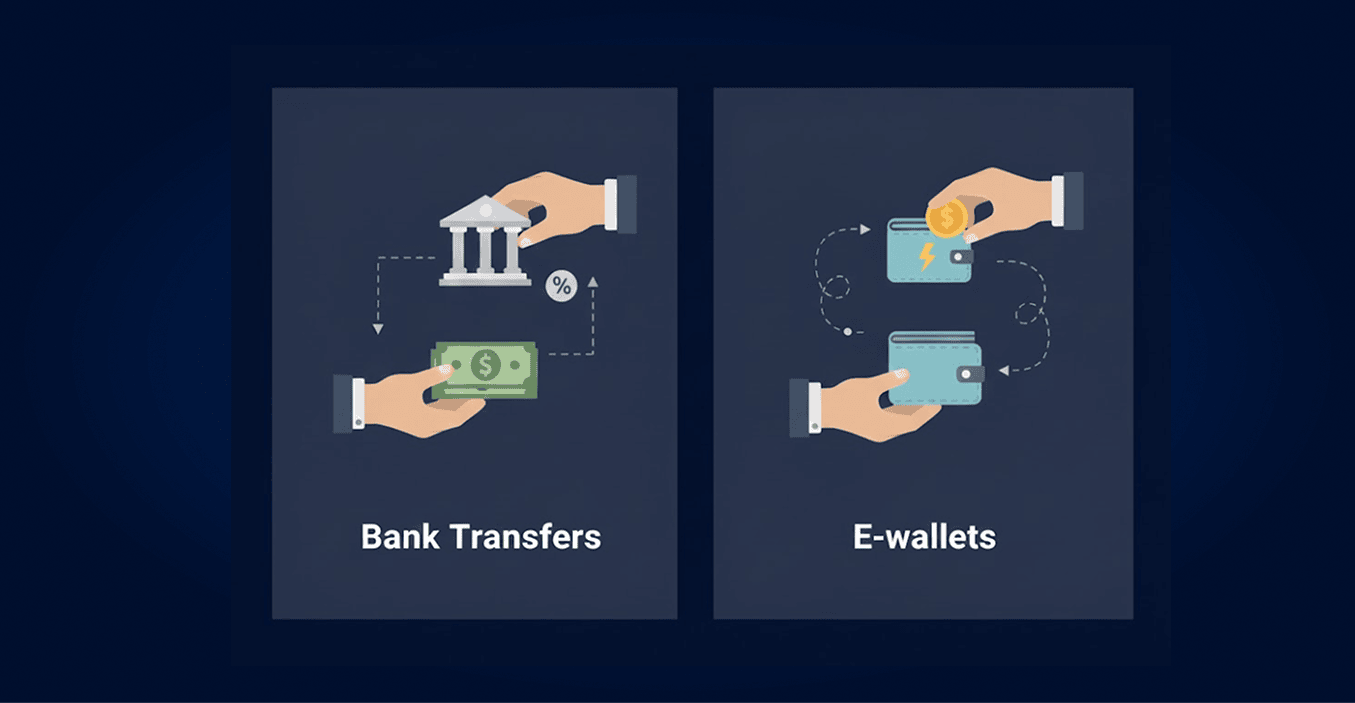
Before we get into the main topic of discussion, we need to know exactly what the payment methods we are actually talking about are:
Bank Transfers
It’s a way by which you move money directly from your bank account into another person’s account. More like a handshake, except this one’s for financial transactions, with money changing hands. The transfer can happen between people in the same country or across borders, and rely on networks established by banks to get the job done.
Banks have been doing this for years; it’s a pretty straightforward process, but may often involve many intermediaries, especially when the payment is international. This can make the process slow or add extra fees along the way.
E-wallets (Digital Wallets)
An e-wallet, which some call a digital wallet, is more like your physical wallet’s tech-savvy cousin. A digital product (think PayPal, Bitania, Venmo) that stores funds electronically, which is where the ‘e’ comes from. It lets you manage your money through a mobile phone app or an online platform.
E-wallets serve as virtual accounts – they hold your payment info, and with them you send money, receive money, and store money all in one place. This convenience is the beauty of it – once you have an internet connection, you get to access your funds from anywhere at any time.
However, here’s something you need to take note of: many people often use “digital wallet” in place of “e-wallet.” But there is a subtle difference between an e-wallet and a digital wallet.
An e-wallet is especially for storing pre-loaded funds you want to use for transactions. Digital wallets, on the other hand, are broader; they can either link to your bank accounts or existing cards without necessarily storing the funds themselves.
For the purpose of this article, we will be focusing only on e-wallets since they are what most people nowadays use for P2P payments.
Bank Transfers vs. E-Wallets: The Ultimate Comparison
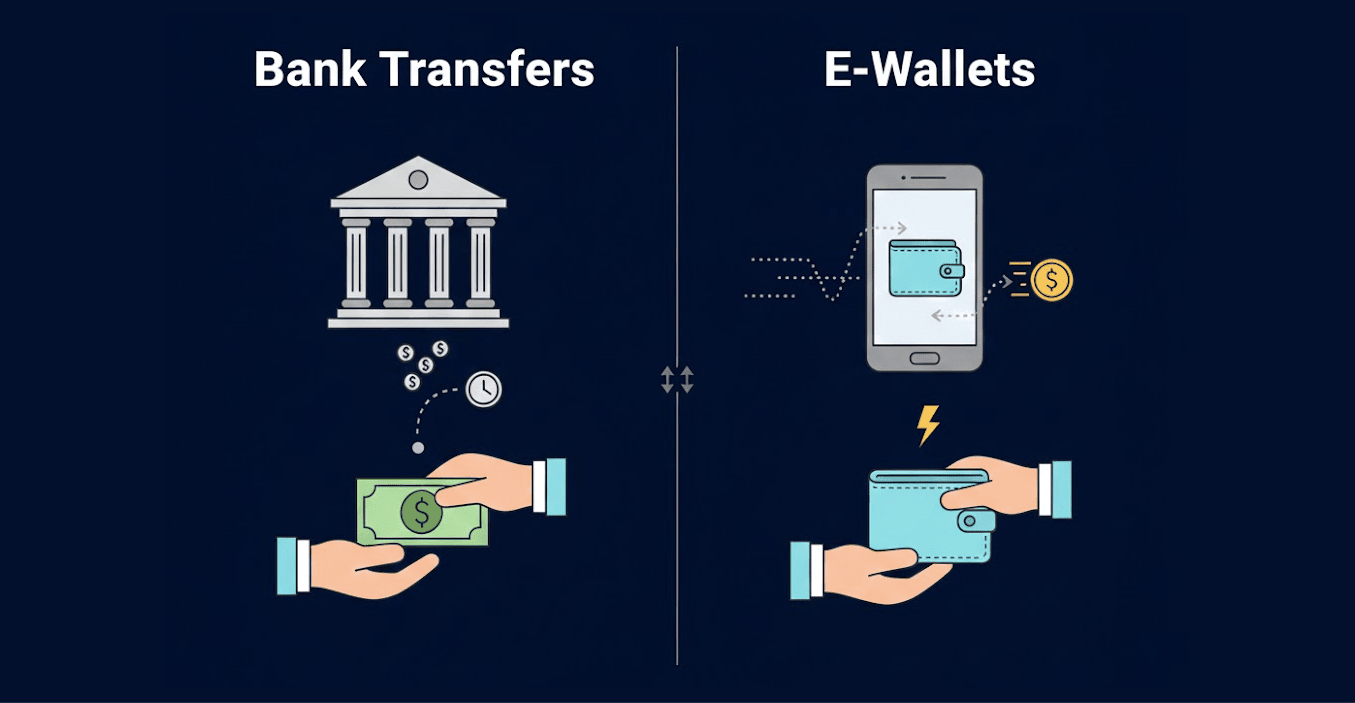
On the fence in choosing the best payment method for P2P, this head-to-head comparison could be just what you need to help you decide:
Speed and Efficiency: Which Method is Faster for Sending Money
Now, this part is really important for all of us because, let’s be honest, no one likes waiting forever for their money to drop. So, speed matters a lot, especially when you’re trying to split the bill at a dinner or paying a contractor who needs their cash ASAP.
E-Wallets Take the Lead in Terms of Speed
E-wallets process payments almost instantly – the person you’re sending the funds to can access them immediately. This is a big win for gig workers, freelancers, and anyone who depends on fast modes of transferring money.
After testing multiple platforms, we observed that most transfers done via e-wallets are completed in less than a minute for domestic transfers. This fast speed is not only convenient, it’s also bringing real improvement in how people work and live. When you get paid the moment you finish a task, it makes the entire experience smooth and better.
Bank Transfers Lag Behind in Terms of Speed
Traditional bank transfers are more like you leisurely taking a stroll. Domestic transfers can take between hours and a whole day, or sometimes two days to clear, depending on the network efficiency. Transfers to other countries can take time – usually 2 to 7 business days, and sometimes it can even take longer.
Why so slow? Transfers can involve multiple banks, especially for cross-border payments. Each of these entities adds to the processing time. Plus, banks often only work during business hours, so if the transaction was initiated during the weekend, it’ll have to wait.
Verdict: If you want your money sent fast, then e-wallets should be your go-to.
Cost and Fees: Which One Costs More?
Transaction costs can really eat into your payments, especially if you send money often or with larger amounts.
E-Wallets Keep Costs Low
E-wallets can really keep those costs down. They usually charge less than regular banks. They skip the middleman and do things digitally, which cuts out a lot of extra costs.
We checked the fee info from over 15 payment places, and most e-wallets charge about 0% to 3% for each send, depending on what you’re doing and the service you choose. Many of them even let you send money inside the country from person to person for free.
That’s cool for things like paying freelancers or sharing rent and food costs with roommates. If you make small sends all the time, those little savings can add up fast. Some platforms, like Bitania, are really good—they offer rates that are fair, whether you’re sending money for yourself or for your job.
Bank Transfers Can be a bit Costly
Banks, though, can be pricey, mostly if you’re sending money to other countries. First, there’s the send fee. Then, you have to pay fees to change the money to a different currency, and sometimes extra fees from other banks that are part of the process.
For example, if you send $1,000 from the U.S. to the Philippines using a normal bank, you’ll pay $45 to $65 just in fees. Add another 2% to 4% lost when they change the money, and you might lose $65 to $105. That’s more than 10% of your money, gone before it gets there.
It all gets to be too much, in a bad way. For companies that handle payments all the time, these fees can really lower how much they make. Even if you’re just sending money to your family, you pay extra and wait longer.
Bottom line? E-wallets give you a better deal.
Global Accessibility: Reaching Everyone
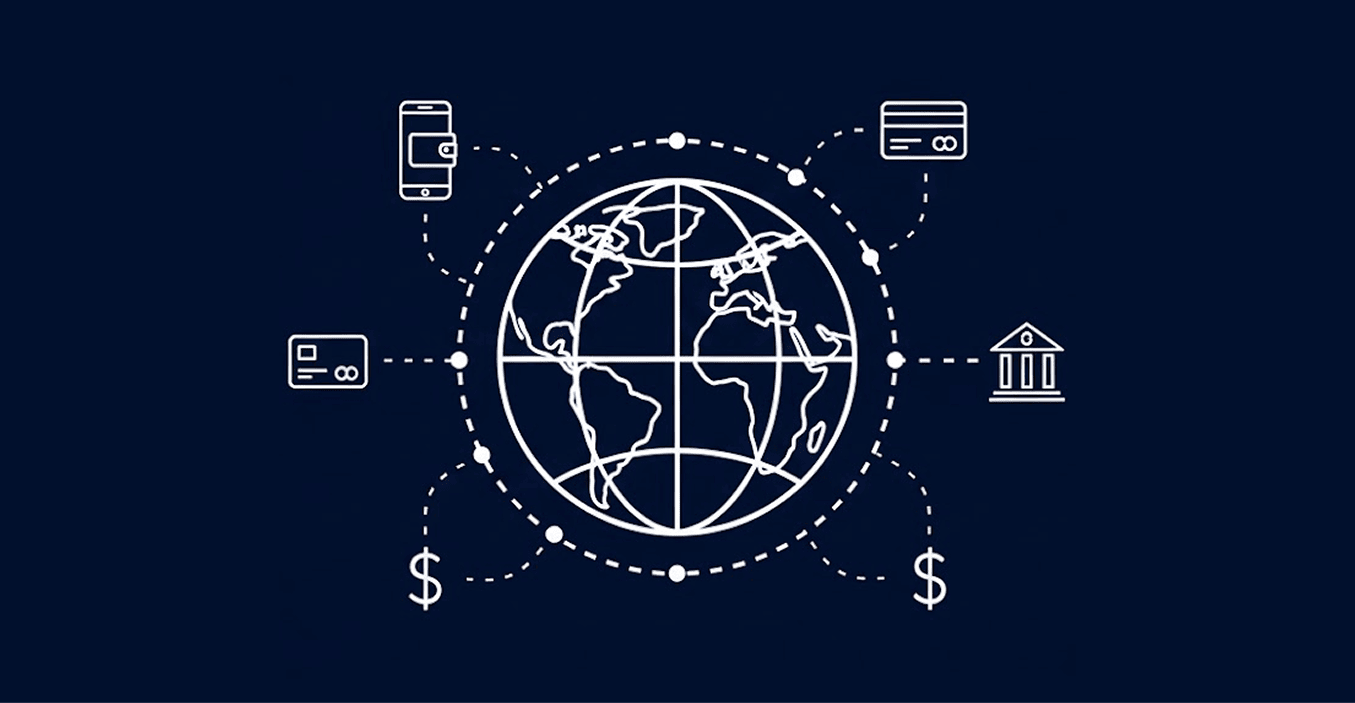
Not everyone has the ability to access or use a traditional bank. When you want to send money within another country, this can be an even larger challenge.
Where Banks Don’t Operate E-Wallets Do
For individuals living in areas of the world where access to a bank is limited, e-wallets provide a viable means to send funds without needing a traditional bank. E-wallets are great because all you need is your phone and the internet.
The World Bank says about 1.4 billion adults don’t have a bank account. This means that e-wallets enable more adults to participate in the digital economy and allow companies to pay their international contractors, as well as enabling families to send remittances back home, for a very low cost.
E-wallets have created an opportunity for those who previously did not have access to a banking system.
The Infrastructure Required for Bank Transfers
The infrastructure required for bank-to-bank transfers makes it difficult or impossible for many people around the world to transfer money. In most cases, both the sender and the receiver of a bank transfer need to have a bank account, or they cannot send or receive money via a bank transfer. This limits the ability of many people to move money internationally, regardless of their location.
For some people, the expense of opening a bank account may be an issue. Meanwhile, for others, even if a bank is located close by, the cost, inconvenience, and lack of ease to open a bank account may also deter them from doing so. The lack of access to a bank account for many people creates a major barrier for many individuals and businesses who wish to transfer funds internationally.
In contrast, the use of an e-wallet allows many people from all over the world to easily transfer money.
Flexibility & Ease of Use
How easy is it to use an e-wallet for everyday payments?
E-Wallets: Simple and handy
E-wallets offer a simple and efficient way to send and receive money. You can quickly create a new e-wallet account and once it has been created, money is sent to you shortly after. There’s also the option to move your money to a bank account, withdraw cash, or shop online, all within your e-wallet.
The e-wallet goes beyond just transferring funds. They also provide options for common issues such as splitting bills, requesting payments, and connecting to other financial software.
E-wallets make everything very easy to do, and therefore reduce the stress associated with managing funds and sending and receiving funds in the modern world.
Bank Transfers are Sticking to what Works
While Bank Transfers accomplish what they’re meant to do, there’s no denying that there are some serious limitations. Once funds are transferred into an account, that account has very few options; therefore, the Bank Transfer System is not as adaptable as the average consumer would like these days.
In addition, e-wallets do not require you to look up any Banking information when adding payees; you just need either the Payee’s phone number or email address! This is a significant benefit compared to Bank Transfers.
Overall, the real advantage of using an e-wallet is the flexibility and ease of use.
Securing and Complying with Legislation: Which Method’s Safer for Your Funds?
When it comes to transferring funds, there is no room for error in this arena with regard to safety. As both Banks and e-wallets take security measures seriously, they will approach this in different ways.
The Use of Modern Technology by e-wallets
As e-wallets are increasingly relying on the newest security technologies, including Encryption, 2-Factor Authentication, and Identity Verification. For secure P2P payment options, many e-wallet services, like Bitania, integrate compliance into their products, ensuring that they are operating within both local and global regulations. This creates a situation where users are better protected than in the case of traditional banking.
Bank Transfers: Old-School Security
Banks have really tight security and rules. Plus, in the US, the FDIC usually insures your money. Sending money abroad can be tricky, and because you’re doing things manually, mistakes can happen. Also, having more people involved just raises the chance of something going wrong.
Verdict: Both ways are safe, but e-wallets might be a bit safer because they have extra digital protection and follow the rules automatically.
Key Differences Between Bank Transfer and E-Wallets at A Glance
In a hurry? This table below summarizes the key things that set both payment methods apart from each other:
| Feature | Bank transfer | E-Wallet |
|---|---|---|
| Speed | 2-7 business days (slower) | Instant to minutes (faster) |
| Cost | Higher fees, especially international | Lower fees, more economical |
| Accessibility | Requires bank account | Works without bank account |
| Global reach | Limited by banking infrastructure | Widely accessible globally |
| Setup complexity | Requires detailed account information | Just email or phone number |
| User experience | Rigid, traditional | Flexible, modern |
| Transaction limits | Generally higher | Daily/weekly limits apply |
| Security | Traditional banking security + FDIC | Advanced digital security (encryption, 2FA) |
| Best for | Large, one-off payments | Regular, smaller payments |
| Processing hours | Business hours only | 24/7 availability |
| Reversibility | Possible with bank intervention | Difficult to reverse |
| Ideal users | Corporate accounts, large transactions | Freelancers, gig workers, and everyday users |
Bank Transfer vs. E-Wallet: The Real Pros and Cons
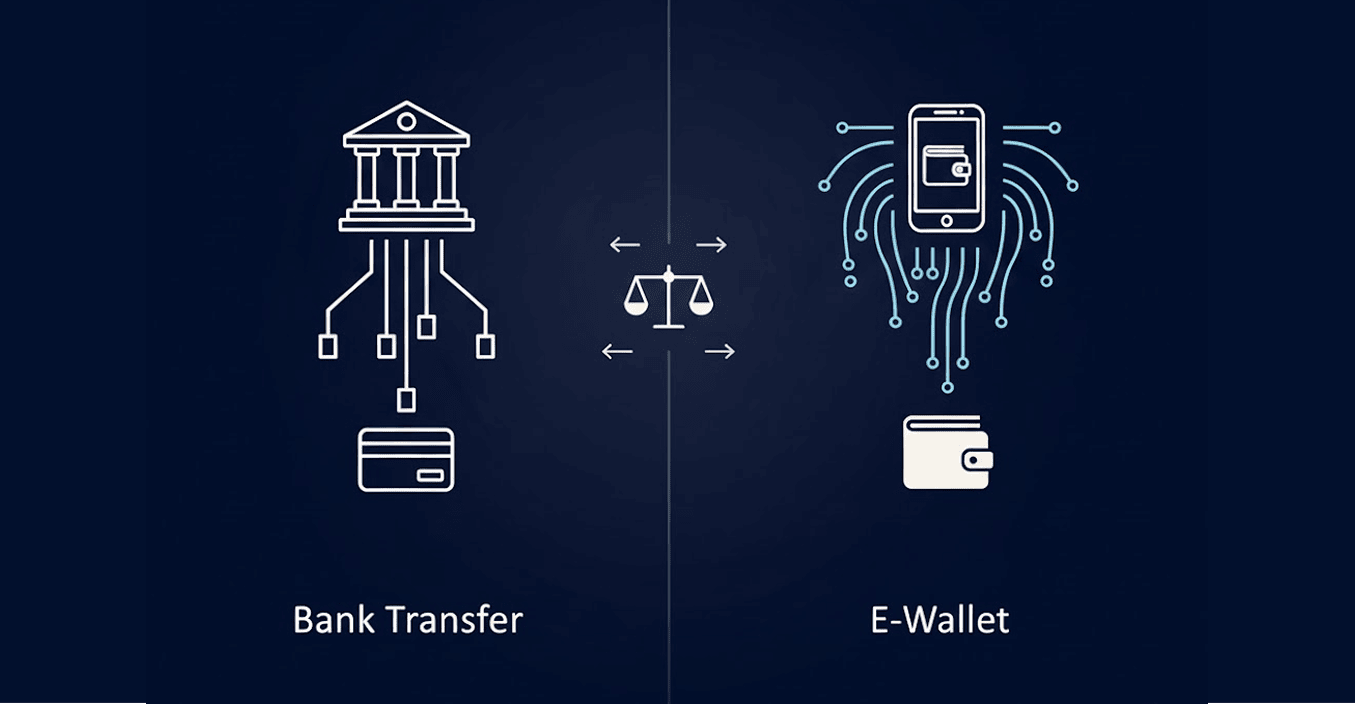
To be honest, banks have their own perks and so do e-wallets. Both also come with issues that’d make you want to take to your heels. Having wired money for a house down payment one month and then Venmo’d a friend for pizza the next – here’s what’s good and what’s not in real life.
Bank Transfers Pros
- Banks have been around for a long time, so most people feel sure about using them more than the many newer payment methods out there.
- Your money in the bank is secured by insurance – think FDIC in the US, which ensures your money up to $250,000 is safe. You don’t get that with most e-wallets.
- If you’re moving a lot of money, banks can do it. They’re set up to handle those transactions.
- Almost everyone (in developed countries) has a bank account, so sending and getting money to anyone via a bank transfer is usually easy.
Bank Transfers Cons
- Waiting days for your money to show up stinks, especially if you need it fast.
- There are charges for the transfer, middlemen taking their share, and extra costs for exchanging currencies if you’re sending money to other countries.
- If you don’t have a bank account, you’re stuck.
- Adding someone new to your send list can be a real drag, and even a tiny mistake can slow things down.
- With bank transfers, you don’t always get instant updates, so you’re stuck wondering if the money actually made it.
E-Wallet Advantages
- E-wallets are way faster; the speed is genuinely addictive, with transfers done in seconds. Paying your share of a group dinner in ten seconds? That’s not just convenience; it changes how money moves from one hand to another. The instant-ness is life-changing, honestly.
- Fees are usually lower, so your money goes where it should.
- More accessible. They’re great for people without bank accounts, giving more people access to the digital world.
- The apps are easy to set up and use, with simple designs and features that make things easier, like payment requests.
- You also have many choices – lots of ways to spend, get, or send money.
- Global reach – Sending money to other countries is easier and cheaper with e-wallets than with banks.
E-Wallet Disadvantages
- Most e-wallets don’t have FDIC insurance, so what if something goes wrong with the platform? Your money could be at risk.
- There are also limits to the amount you can send – daily or weekly amounts that can be annoying if you need to send a big payment. Tried to send a contractor $8,000 via one e-wallet last month, and guess what? I hit a weekly cap – for such a scenario, you’d have to split the payment into two, and to be honest, that just feels like some kind of criminal stuff.
- Scams are rampant, too. Once payment enters the wrong hands, you can kiss it goodbye. That just makes it easiest for scammers to run with your money. Banks at least have a way to claw back your money, though it can be slow.
- You need a smartphone or internet to use an e-wallet, which leaves some people out.
- Limited Acceptance. Many still don’t accept e-wallet payments yet.
Use Cases: When Should You Use Each Method?
When is it okay to use a bank transfer or an e-wallet? Which method to settle for will depend on what you need it for.
When E-Wallets are the Way to Go
For those who prefer a fast, cheap, and easy way to send money, ewallets are tough to beat. They’re perfect for:
- Gig payments: You are paying an Uber driver, a deliveryman, or a freelancer who wants their money right away (once saved $78 in fees last time using Bitania instead of my bank app to pay one graphic designer I met online).
- Affiliate marketers: Making payouts to influencers or partners who help promote your stuff in due time without delays.
- E-commerce: Quick, low-cost payments to suppliers or customers.
- Every day, smaller payments: Splitting the dinner bill with your three friends who also use different banks, or sending someone their weekly allowance. (I swear the Venmo/Bitania group request feature can save marriages.)
- International freelancers: Paying contractors overseas without getting slammed by wire transfer fees.
- People without bank accounts: Great for folks in places where banks aren’t easy to reach.
Honestly, if these sound familiar, P2P platforms like Bitania make the whole process fast, affordable, and painless.
Go with Bank Transfers When
Still, bank transfers have their place, especially if you’re dealing with:
- Large, one-off payments – Like buying a car or putting a down payment on a house.
- Traditional business transactions – Companies that need a paper trail and official banking records for verification.
- The recipient doesn’t trust “those app things” and prefers banks. Sometimes, the person you’re paying might prefer the good old-fashioned bank transfer (some landlords fall into this group).
- Maximum security always trumps convenience: If you need insurance protection, like the kind FDIC provides for bank accounts, and a complete peace of mind, then bank transfer is no doubt your go-to method (think tax or mortgage payments).
- Legal requirements: Some transactions just have to go through a bank, plain and simple.
At the end of the day, it all comes down to picking what fits your situation. For most everyday P2P payments between friends or freelancers, e-wallets make life easier. But for big, official transactions, banks still get the job done.
FAQs
Both have their own way of keeping things safe — bank transfers have insurance (up to $250,000 for the FDIC-insured in the US). E-wallets use encryption and two-factor ID. Biggest difference? E-wallets lack FDIC backing, but big names use bank-level security like fraud checks. If you’re smart with passwords and double-check payments, both work.
Yep! That’s what’s so good about them. Load up with cash or get paid by friends. Great if you don’t have a bank but want to shop online or send cash. Some let you spend or take out money at ATMs without a bank link.
Great question – even some techies get it mixed up. E-wallets are essentially online piggy banks you can store money in for things like P2P transfers. A digital wallet is broader, like your physical wallet, except it’s on your phone – it links your bank account, cards, loyalty passes, and sometimes tickets too. Most people just say digital wallet for everything, but technically, Apple Pay is a digital wallet, whereas your Binance wallet, WeChat Pay, etc., is an e-wallet.
Absolutely, and this is key. Most ewallets limit spending to be safe. Expect around $2,500-$5,000 weekly for normal accounts. Verified users might hit $10,000-$50,000. Bank transfers usually move more money around. So, check limits if needed.
E-wallets are quick – money comes in instantly or in minutes. Bank transfers take 1–2 business days in the US. International? A week or more. E-wallets win for speed. Moving money from e-wallet to bank can still take a day or two, unless you pay a little fee for fast cash out.
For personal gifts and reimbursements? No. Just sending your friend $50 for a ticket is not taxable income for the receiver. But payment for goods, services, or business? Yes, those are incomes you need to report. If you’re a freelancer getting paid via Bitania or selling items, you’d need to report that income. The P2P platform may issue you a 1099K form for payments that cross certain thresholds ($600 under current rules in the US). If you require more clarity, consult a tax professional.